Early Days — the Narrows Channel
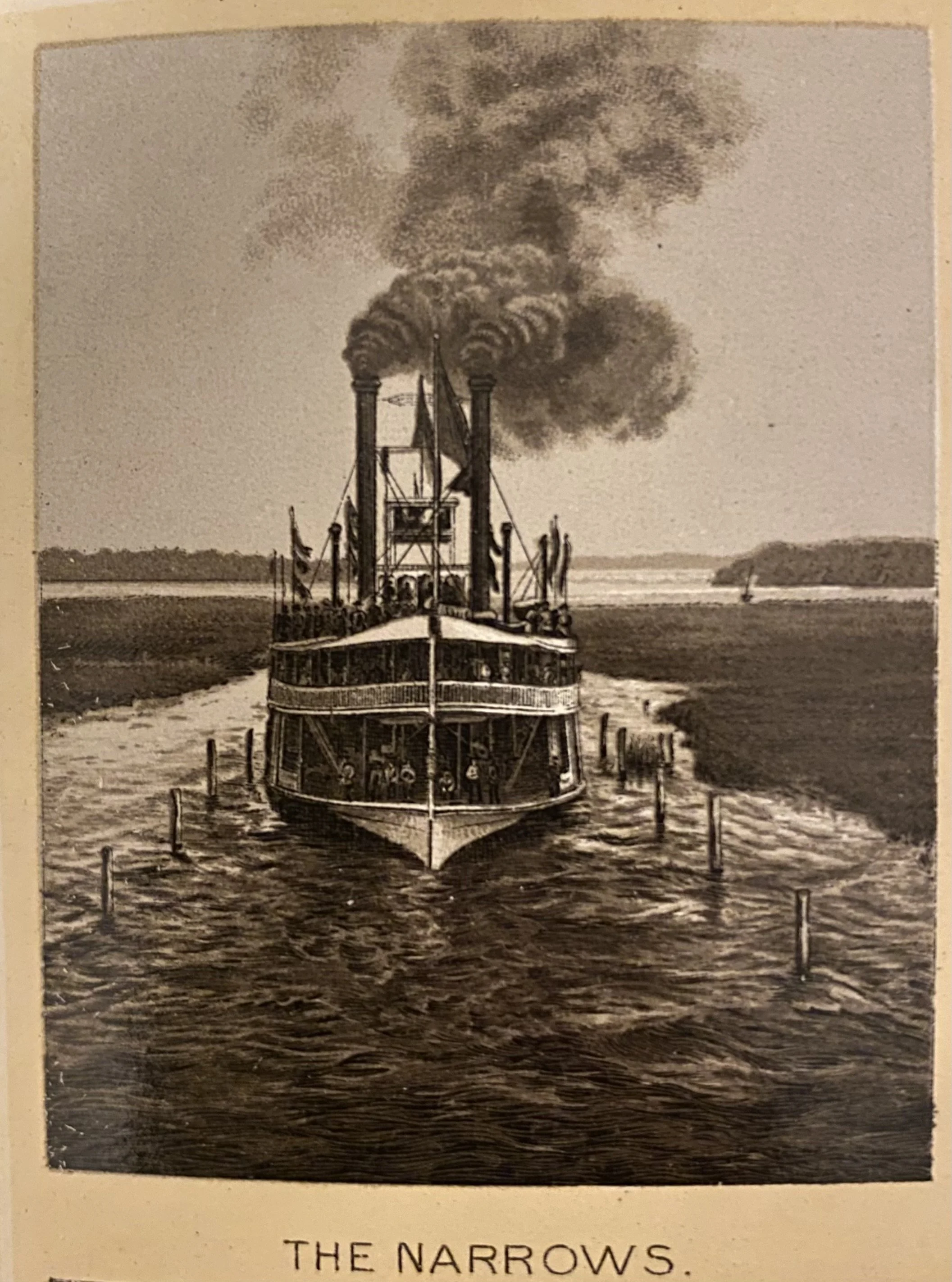
It’s no surprise that, today, many of the most seasoned boaters can’t easily tell which of the lake’s channels are natural and which are entirely manmade. For some it would seem obvious that the Narrows Channel, which splits the cities of Orono and Tonka Bay, is not a naturally occurring one. However, there was a version of the Narrows which was formed by Mother Nature.
The original channel, known as Hull’s Narrows, was a shallow and mucky creek which crossed the land-bridge between the eastern and western halves of the lake. Lake Minnetonka was formed through a process known as glaciation, which is when ice glaciers repeatedly expand and recede across a landscape, causing the ice to carve down into the soil below. As this happens, melting glaciers would deposit sediment which would become the basis for the lake’s formation. This process left the Narrows as the only outlet from Upper lake to Lower Lake and, even then, it was only a small stream of water.
The name “Hull’s Narrows” stems from Tonka Bay resident Rev. Stephen Hull who owned a claim along the original channel and, for travelers wishing to cross, Reverend Hull was the man to find. For early lake settlers the Narrows was a barrier to be crossed to access “Island City” which would later become Navarre and, in the 1873, it was dredged and widened to allow steamboats to more readily sail through. At the same time, pilings were added along the channel’s muddy embankment to help guide boats through the only part of the channel which was deep enough to allow their passage. It wouldn’t be long until with the lake’s first steamboat, the Governor Ramsey, traveling through the channel to bring tourists to the remote Upper Lake.
As time went on and the boats got bigger, the channel seemed to get smaller. In 1881, the 400’ long and 48’ wide City of Saint Louis launched into Minnetonka and made regular trips through the Narrows channel. The image seen above is an 1886 lithograph of “the City” sneaking between the channel’s pilings. One year after the City’s launch, James J. Hill launched the much larger Belle of Minnetonka. The 285’ long by 56’ wide Belle was barely able to make passage through the Narrows, but competition among the two “palace” steamers demanded she press onward. To local residents and officials, there was clearly a need for something better. . .
Dredging began on a new channel slightly further North which would be substantially wider and deeper than the original had been. In fact, the new channel was so wide that, prior to having a bridge, it would necessitate a dedicated ferry to bring travelers from one side to the other. The “New Narrows” was completed in 1887 and opened to the public. Not only was it larger, but its sides were shored up to forevermore prevent the shores from squeezing boat traffic.
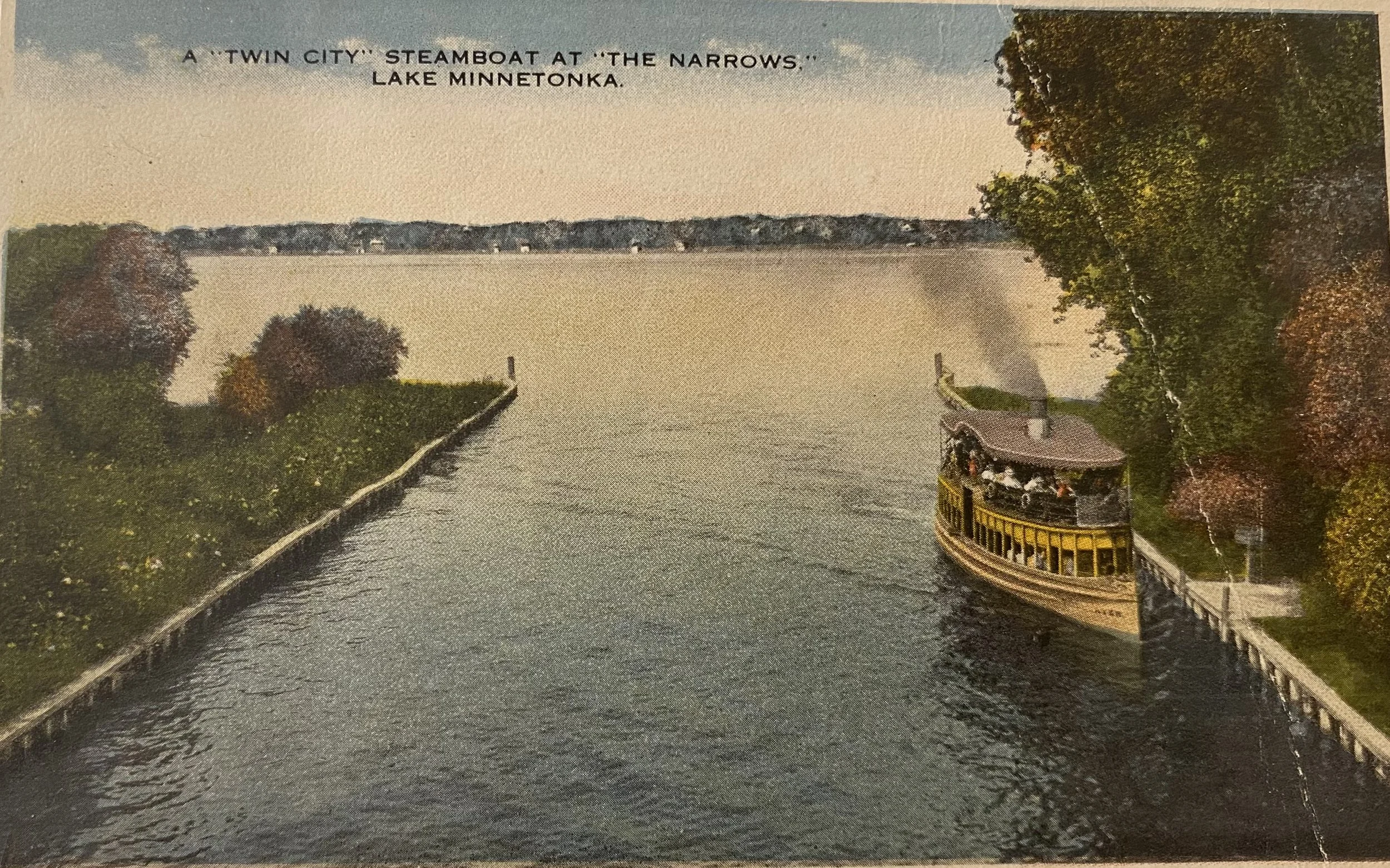
Steamboat White Bear traveling the New Narrows.
Today, the "New Narrows” channel is just known as the Narrows. A name which, to the unknowing boater, seems to be an unfitting title. It is, after all, one of the widest and deepest channels on the lake! Meanwhile, the old Hull’s Narrows, now known as Old Channel Bay, had been partially filled to allow for the passage of Shadywood Road (Hwy 19). The remaining portion still has use in allowing lake access to a substantial number of homes that aren’t on Lake Minnetonka proper but, similar to the efforts of 150 years ago, requires dredging and vegetation control to be navigable.
For those seeking a summer boat ride into history, I often suggest a ride around Big Island and into Hull’s Narrows. This seven mile loop gives visitors sights of Golden Era cottages, Big Island Amusement Park remnants, and a view of a channel largely forgotten by the community. This loop is among the most serene that can be had anywhere on Minnetonka!
Learn about the Belle of Minnetonka by clicking below!
Author’s Note:
This article was among my first, but was both incredibly short and not well guided. What you’ve read is a lovingly revised and more accurate version of my earlier work.
Bibliography of Sources:
A Directory of Old Boats, McGinnis, 2010. Pg. 15-18, Pg. 37-41
Once Upon a Lake, Jones, 1957
Picturesque Minnetonka, S.E. Ellis, 1906
Lake Minnetonka Place Names: https://www.minnesotahistory.org/post/the-history-of-lake-minnetonka-s-bays-points-and-islands (For reference, not wholly accurate across all of Minnetonka)
All photos sourced from the Minnetonka Minute private archive.
Lithograph by Wittemann Bros. New York, 1886. Lithographer - Louis Glasser