Settling Minnetonka — Lydia Ferguson
When looking back at our community’s past we often get wrapped up in Minnetonka’s Golden Era, which lasted from about 1880 - 1914. Of course, there’s much history to share from both before and after that time. Today, we’re focusing on some of the earliest days of settlement around Lake Minnetonka, and looking through the lens of two of the area’s most well remembered figures of the era, William & Lydia Ferguson.
From 1850 to 1857, settlers found their way to the Minnesota Territory in droves. Truly, droves is the best way to describe it. The territory was acquired by the U.S. Government in the spring of 1849 and had an American population of roughly 6,000 people. By 1857, that number had ballooned to over 150,000. That is an astonishing increase of 2,400% in just seven years! In the Minnetonka area, most settlers were of German, English, Irish, or American descent. Some came for health conscious reasons while others came for the prospect of clean living and abundant, cheap, land.
In the case of the Furgusons, it seemed to be a desire for the romantic life of the frontiersman. That was forty-year old William Furguson’s desire, at least. For his twenty nine year old wife Lydia, there was no desire whatsoever. In the winter of 1854, as William read aloud the weekly New York Tribune to his wife, he came across a section of paper describing the land surrounding Minnetonka. A beautiful locale, stunning views, soaring woods, and fertile land to be cleared and grown upon. The government was offering parcels for sale, too!
160 acres of land for $1.25 per acre. Purchasers must build a cabin, no less than eight feet by ten feet. It must have a floor, at least one window, one door, a stove, and a bed. In addition, they must clear at least one acre of the land, visit the home at least once per month, and swear allegiance to the U.S. Government. Imagine buying 160 acres of land, on Lake Minnetonka, for only $200! Even after adjusting this price for inflation, it’s nowhere near modern lakeland values.
Unlike a good percentage of Minnesota settlers, the Furgusons had been New York residents. They were financially sound, educated, and well employed. Lydia implored her husband to reconsider the move but he wouldn’t have it. She cried, bargained, and begged to no avail. He had said to her simply, “wife, that lake — that is where I am going to live and die.” From there, they were off. . .
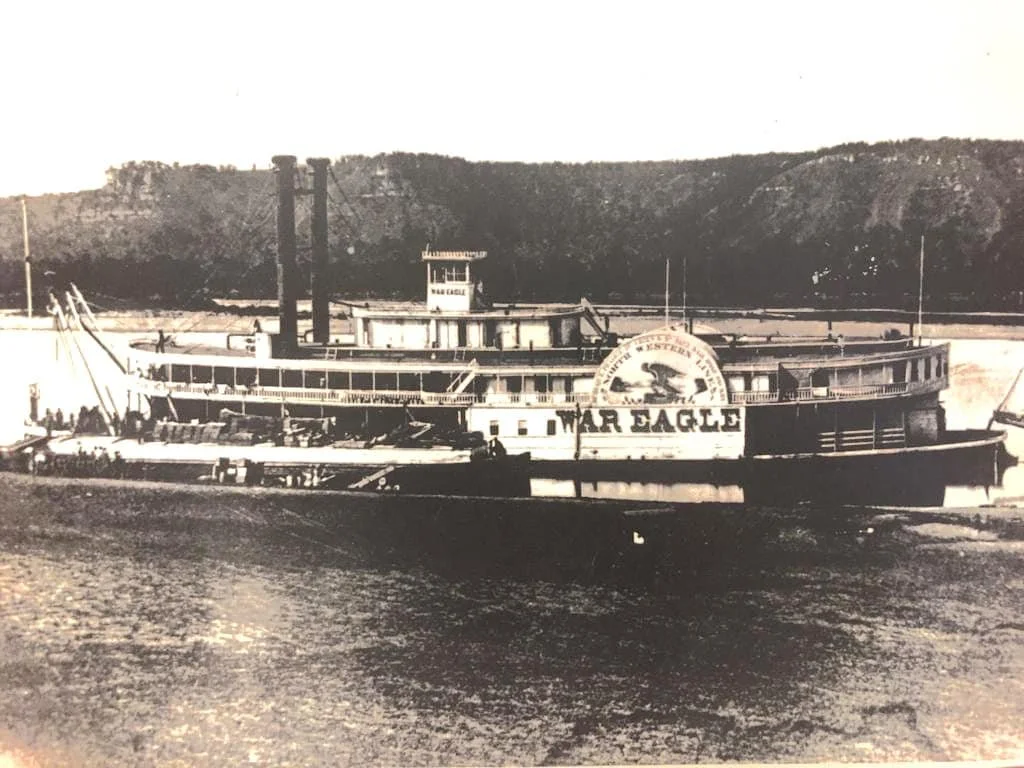
Off indeed, but in no high fashion. William procured a canal-boat for themselves and their two young children, Willie and Alice. The boat took them from Buffalo to Lake Erie, then a train to Galena. There, they boarded the steamboat War Eagle —which was operated by the same company to build the predecessor to the Belle of Minnetonka, the Phil Sheridan—and made landfall in Saint Paul on May 22, 1854. The trip had taken them fully 20 days, and there was still the thirty some miles to contend with between Saint Paul and Minnetonka. The whole way Lydia cried for the death of her past life, the loss of her friends, her family, and any form of sophisticated living. Asthma stricken and fearful of wild animals, native tribes, hunger, cold, and more, she was distant at best and inconsolable at worst. The only thing to give her some solace was a rosewood piano which she’d brought all the way from New York. However, once she arrived at Minnehaha Creek, she was told more horrible news. The piano she loved so much, and had dragged all this way, was too big to make it into a boat and up the creek. Like everything else she loved, it had to be left behind. All the while, a foreboding feeling loomed over the woman. An unshakable feeling that something horrible would befall her family at their new home, but William wouldn’t hear it. His insistence was simply that they should have come ten years sooner, and had to make up for lost time in the boundless wonderland they now called home.
If all other circumstances for her new home weren’t enough, Lydia exhibited a strong fear of the water. One which William felt was necessary to overcome. Through the summer she managed to gain skill and confidence with the family’s canoe which put her mind greatly at ease until on September 21, 1854 a fellow resident, Mr. William Lithgow, died while sailing through a storm. While a search was done, Lithgow wasn’t found until his body washed ashore. After the event, Lydia’s fear of the water became all-consuming. When William failed to return home from an excursion to help a neighbor harvest potatoes, she had scooped up her children and fled their home; determined that her husband had drowned. Of course, he reappeared and all the hoopla was for not…
The winter of 1856-57 was a horrid one. Temperatures dropped to forty below and spring was late in its arrival. Lydia’s mother had been spending the winter with the family and was unimpressed with their new lifestyle. Upon her leaving, she said simply, “I fear some day I’ll hear one or the other of you drowned.” At the sight of her mother’s foreboding, Lydia’s deep fears of water and fate were triggered, and she broke down in tears.
In the early spring of 1857 William, packing for his trek to church, was reminded of the lover’s agreement to not tread out onto the thawing ice. He assured her he would take ample precautions, kissed Willie goodbye, and headed on his way to town. By the afternoon, he hadn’t returned. No worries, and Lydia put it out of her mind. As the sun set, her fears had spiraled out of control, and she shouted his name into the woods from her cottage doorway. Willie and Alice implored her to stop, and she regained some measure of composure. Through the darkness of the Big Woods, she saw a distant light flickering and, as it approached, she could make out the shape of two figures hurrying toward her. Excelsior residents Reverend Galpin and Mrs. Watson, stood in her doorway and, before they said a word, Lydia spoke simply. “My husband is drowned.” Indeed, that was the case. William had been seen going through the ice in Saint Alban’s Bay by another resident who rushed out with a board to save him. He clamored out of the water but broke through again and, this time, didn’t resurface.
Later, his body was found and brought for burial near their cottage. When offered, Lydia refused to leave their homestead. She was determined to stay. Not a devoted lake settler and no longer a New York socialite, she was imprisoned in a limbo which she’d never escape. Another man, William Holtz, came and went from her life as her short-lived husband before they divorced. Again, she was alone.
Her son Willie was mentally disabled and, as he grew, retained the mental capacity of only a child. Alice grew into a beautiful girl who rebelled her mother at every turn. At fourteen, she up and left for Minneapolis. Lydia lived in poverty with Willie. The two came to the brink of starvation more than a few times, too. As time wore on and the lake’s population grew, she found her position increasingly exploited. Property fences were moved, trees cut down and hauled off by neighbors,, and disdain from new residents who didn’t care for her in the same way the old cohort had.
As the Golden Era arrived, the Minneapolis & St. Louis Railway built tracks over her land. Alice returned from Minneapolis, now married and they opened a hotel, the Linwood House. Alice’s confrontations with her mother continued but her daughter, Nellie, was increasingly fond of her grandmother and entranced by her tales of all that had changed in her forty-one years of life on Minnetonka.
In 1897, on her deathbed, she was brought to St. Barnabas’ Hospital. Oddly, she begged to be returned to the lake. . . To go home to the very place she’d spent her life dejected by. She asked for the water, the ice, and the untamed wind howling through trees older than time. Begrudgingly, she was returned home to a shack Willie had been living in. Nellie tended to her there until her death. She was sixty-nine. . .
No doubt best remembered for her disdain for Minnetonka, Lydia Ferguson is one of the most prominent early Minnetonka residents. Despite holding no titles as Mayor, Reverend, Priest, or even entrepreneur, she is remembered. Her story, while tragic, is just one of many similar tales. A large portion of those early settlers came and went, finding themselves unable to hack it in those rough early days of the Minnesota Territory. Unlike them, she stayed. Perhaps that’s part of why she’s so well remembered. Her refusal to leave, whether from dignity or humility, was important and representative of the era.
Either way it’s certain that, in the end, she found peace with the beauty and peace of Minnetonka.
Author’s Note:
This article is based largely off Thelma Jones’ 1957 book, Once Upon a Lake. Her entry on the Fergusons is much more lengthy and detailed than what I’ve constructed here. I would absolutely recommend that read.
Bibliography of Sources:
Book:
Once Upon a Lake, p. 93 - 105, Thelma Jones, 1957
Images:
Header Image: Paddlewheelers and Steamboats of the World, Facebook Group, Bob Ipcar, 07/2019.
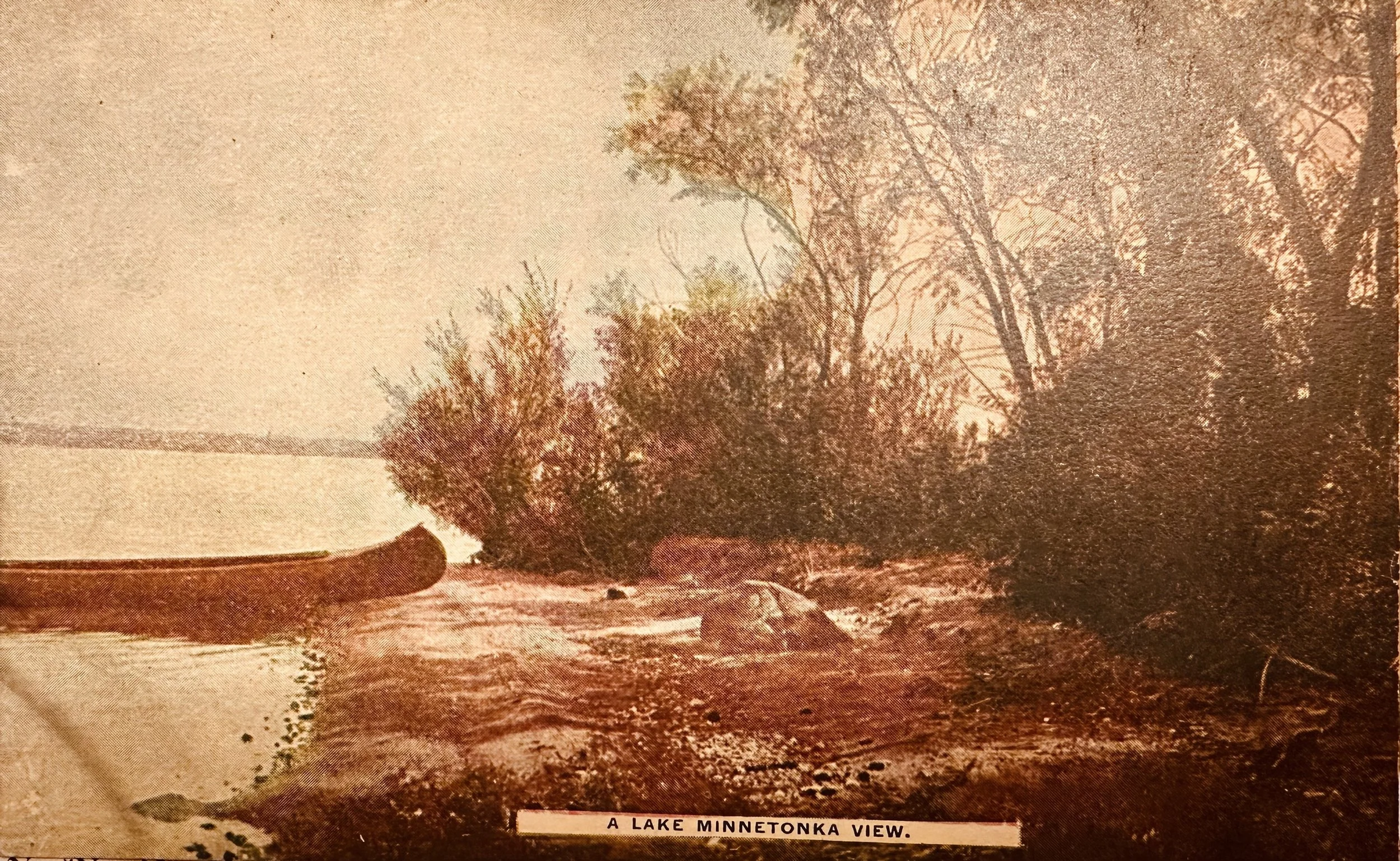
Body Image: Photo postcard from the private archive of the Minnetonka Minute.