The Best Time of the Year!
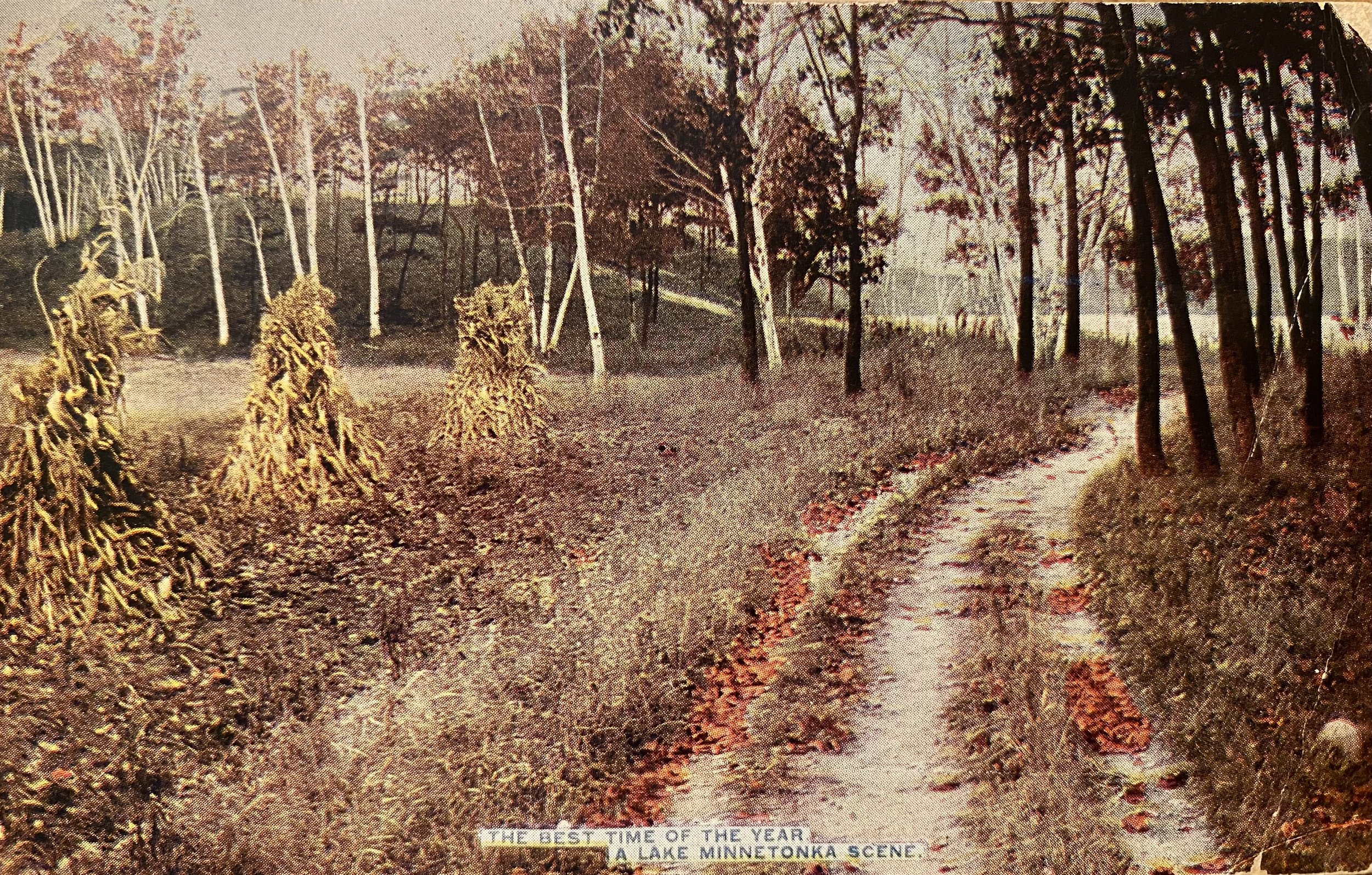
Posted October 11, 1909
As November greets us cooly, many lake area residents can’t help but recognize that the peak fall colors have passed us by once again. Save for the mighty oaks and ever stunning maples, most trees have shed their leaves and relinquished themselves to the coming winter’s embrace.
It’s at this time of year that I often find myself searching through my collection for this colorized postcard from just after the turn of the last century. Posted in October, 1909, the sender writes simply, “When the frost is on the pumpkin - and the corn is in the shock.” It’s one of only a handful of postcards in my collection that is remarkably simple and elegant, yet incredibly topical. Though separated by 116 years, the sender and I have something in common: a recognition that the changing seasons might not be as bad as some folks may claim.
In 1909, before the widespread prevalence of the automobile, many roadways around our community were simple dirt trails. How did they come about? Often, they were built over preexisting native footpaths which had existed for several hundred, or even a thousand plus, years before. Through the use of horse (or oxen) drawn wagons, these footpaths became rutted and well established in the landscape. Later, they would become the foundation for the paved roads we drive on today. For example, both Shoreline Drive and Highway 7 are, in large part, built over these centuries old trails and are the roads many of us drive each and every day. In each iteration of their evolution, the simplicity of using the preexisting trails was too convenient to ignore. After all, why reinvent the wheel?
Similarly, why do we see corn shocks in the image? It’s often forgotten that, until relatively recently, Lake Minnetonka was less a residential hub and more of an agricultural one. Farmland plots dotted the shoreline, housing pigs, cattle, and crops which made practical, working, use of our lake’s shimmering waters. Of course, it’s easy to tell that this image is no corn field. However, many large properties would still grow small batch crops to feed the families that lived on site OR feed guests at the hotels that might be nearby. In a time before Lund’s & Kowalski’s was a brief drive away, these crops provided stable sources of food which, when stored, could be relied upon in even the bitterest days of winter. . .
Yet, to the modern viewer, this postcard still holds a real, tangible, value and charm. We can appreciate it both for what it might have meant in 1909 and for what it means today:
The cozy days of fall, walks through the woods while leaves fall upon us like an elegant snowfall, and time spent with loved ones as we prepare for the winter ahead. Take a moment, if you will, to either enjoy this image or the view that can be found from your own bedroom window. We’re fortunate to exist in a place where, despite the separation of time, we can look upon the same sight as those who came before us.
Enjoy the fall, while it still lingers on the branches of our hardiest trees!