S.S. Minnetonka - The Atlantic Ocean Liner
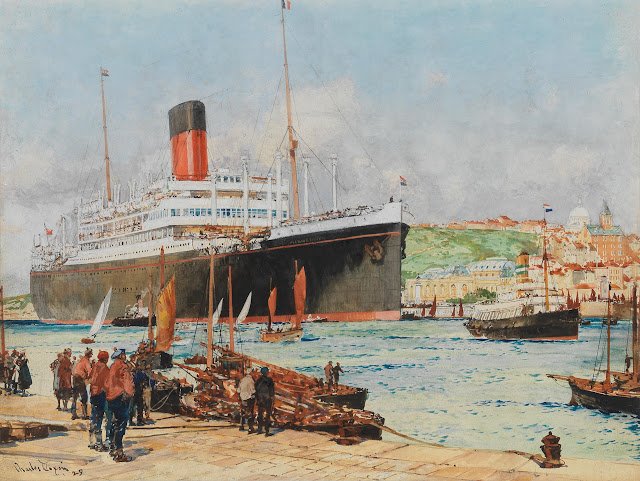
When discussing Lake Minnetonka’s wider impact on the United States during its gilded era, I often find myself calling it the, “Disneyland of its era”. Truly, it’s difficult to understate how well known the lake was, and I feel the phrase often resonates with people. Today, if someone comes home from a vacation and says, “I went to Disneyland!” people immediately know exactly where they were. Similarly, in the 19th & early 20th century, if you came home from a trip saying, “I went to Lake Minnetonka!” your friends would know precisely where you’d been.
It’s no surprise, then, that the name Minnetonka made its way out of our locale in more ways than one. We all know about Tonka Toys, which started in Mound and became a nationally recognized brand that made its way into countless American homes over the course of the last 50+ years. What you might be surprised to learn is that there was a Transatlantic steamship by the name of Minnetonka! Not just one but TWO and, if that wasn't enough, there was also one by the name of Minnehaha. How have we not heard more about these vessels bearing our hometown’s name? The answer is quite simple: they are simply a footnote in the lineage of Transatlantic steamships. There’s much to say, so let’s dive into the subject which I’ve broken down into two separate articles. This one will cover the original Minnetonka, and a later article will cover her second iteration, built in the early 1920s.
Steamship Minnetonka was built as the third member in a group of sister ships known, at the time, as the “Minnes” (Pronounced mini). The fleet was ordered by the British owned Atlantic Transport Line, which was a direct competitor to the much larger White Star & Cunard lines. For reference, White Star Line would later build the famous Titanic & Olympic, while Cunard Lines would go on to build the Lusitania & Queen Mary. This was a time of fierce competition for the Transatlantic passenger route from Europe to America and there were a great number of big players from other nations which we won’t get into here. Suffice to say; the market was immensely more competitive than its modern aircraft equivalent; this is an industry financed by both nations and business tycoons.
Minnetonka was launched on December 12, 1901 and sailed her maiden voyage from London to New York City on July 12, 1902. She was equipped with some of the best technology of her age, even having been one of the first transatlantic ships to be fitted with a wireless Marconi telegraph system. Her personal call sign was designated as MMK. This is the same system that would go on to transmit the famous distress calls of RMS Titanic just a decade later.
Known for their luxurious accommodations, the Atlantic Transport Line’s goal was to build a series of ships which catered to a “first class only” demographic when, at the time, their competition berthed first through third classes. The first ships ordered would be the Minneapolis and Minnehaha in 1900, constructed by Harland and Wolff shipyard in Belfast, Ireland. Both were designed to accommodate 250 passengers while coming in at roughly 13,440-grt and measuring a 600 foot length by 65.5 foot beam. Suffice to say, they were respectably sized for their time. Their introduction to the transatlantic route was an instant success, with the sisters being dubbed as, “the comfort route”. Naturally, the company wanted to capitalize on their success and, in 1902, launched Minnetonka. She was essentially the same size as her older sisters and, again, met with great success in her route across the Atlantic. However, the going wouldn’t stay good forever. . .
After the onset of World War 1, Minnetonka and her sisters were requisitioned into the British navy as troopships. In May, 1915, Minnetonka was rechristened as HMT158 and sailed with little issue for just under two years. However, she would run into trouble in the Mediterranean Sea on February 2, 1917, when she was ambushed by German submarine U35. Despite the attack, she managed to escape without much damage. Then on September 24, 1917, she was attacked again, by German submarine UC34, who she also managed to escape from. Once more, on January 30, 1918, Minnetonka found herself in the crosshairs of another German sub. Submarine U64, under the command of Captain Robert Morhat, struck the ship with a torpedo while she was sailing unescorted to Malta, carrying a load of mail. The torpedo exploded on impact with her hull and damaged her before the Germans fired another torpedo, surfaced, and shot 10 rounds into her from their deck gun. Four crew members lost their lives in the attack and Minnetonka sank beneath the waves with little loss of life otherwise. Ultimately, the four year long World War would prove devastating to the Atlantic Transport Line’s fleet. . .
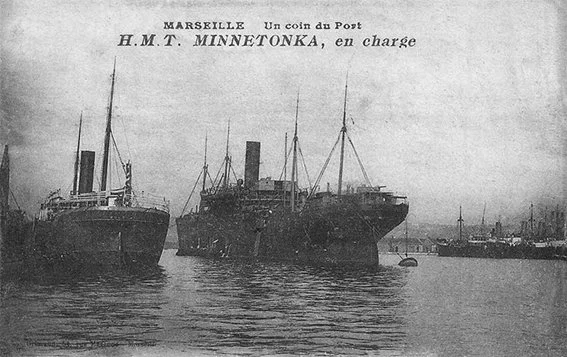
Minneapolis: Destroyed by a German torpedo in 1916 off the coast of Malta, and sank.
Minnewaska: Struck an underwater mine in 1916 in Suda Bay, near Crete.
Minnehaha: Torpedoed off Fastnet, Ireland in 1917 and lost.
Lastly, Minnetonka was torpedoed in 1918 and sank near Malta, just 9 months before the end of the war.
Within just a few years, the entire fleet was gone and the company’s founder, Bernard Baker, had died during the same timeframe. Despite their heavy losses, the company would set an ambitious goal for regaining their position as one of the world’s foremost luxury shipping lines. In 1919, they ordered the construction of two new liners. It was decided that they would carry the name of the grand liners which were lost during the war: Minnewaska & Minnetonka. Yet, this couldn’t have come at a worse time, with a war torn Europe still mending its wounds, there was much trouble on the horizon. For the Atlantic Transport Line, this would only spell delays, losses, and ownership transfers. However, the project would eventually be completed and the Minne sisters would sail the seas once again.
How will the rejuvenated Minnewaska & Minnetonka fare in a new, post war, era of shipbuilding?
Sources & Timelines:
https://www.marpubs.com/30th-january-1918-minnetonka-sunk-off-malta/ - Marpubs Publishing
https://wantedonthevoyage.blogspot.com/2023/09/fleeting-fleetmates-ss-minnewaska-ss.html - P.C. Kohler