Right Place, Right Time: Tugboat Hercules
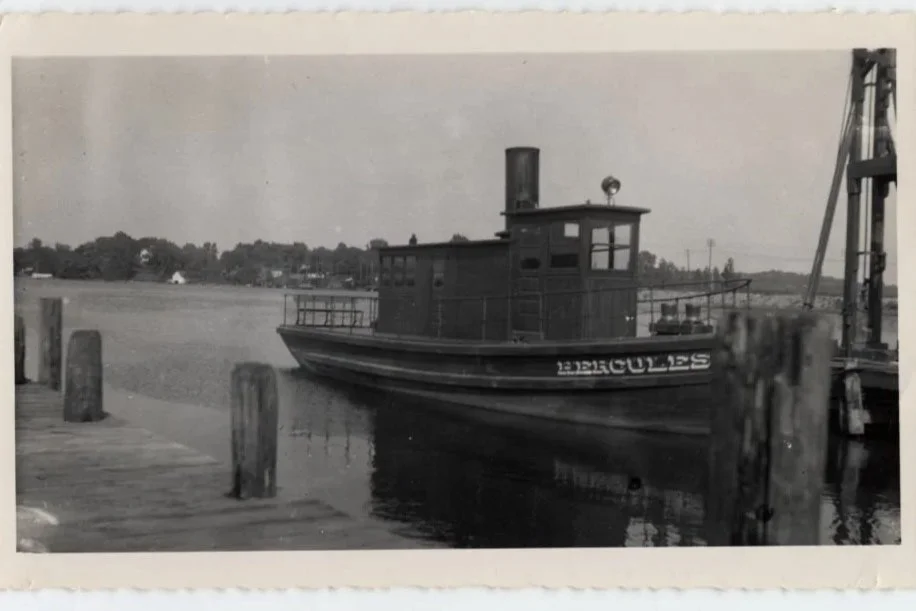
c. 1917
Among the lineage of steamboats to have sailed Lake Minnetonka over the gilded era & beyond, many are quickly forgotten. Whether being lapsed by larger and more glamorous boats or simply irrelevant to the greater lake’s story, they’re overlooked by many of our historians. For the tugboat Hercules, there could be no better assessment than this.
Yet, like so many boats that sailed near the end Minnetonka’s era of steam, Hercules existed at the right place in the right time as to not be entirely forgotten. Built in Excelsior by the Twin City Rapid Transit Company, Hercules was a 50 foot steam propeller tugboat whose claim to fame is just that: being part of the TCRT fleet. Ironically, the most interesting part of her story comes from before she first hit the water. Hercules’ engine was sourced from the older steamboat Mayflower, which was owned by Captain John R. Johnson. The story of the Mayflower deserves its own article which, in the future, we aspire to provide you with.
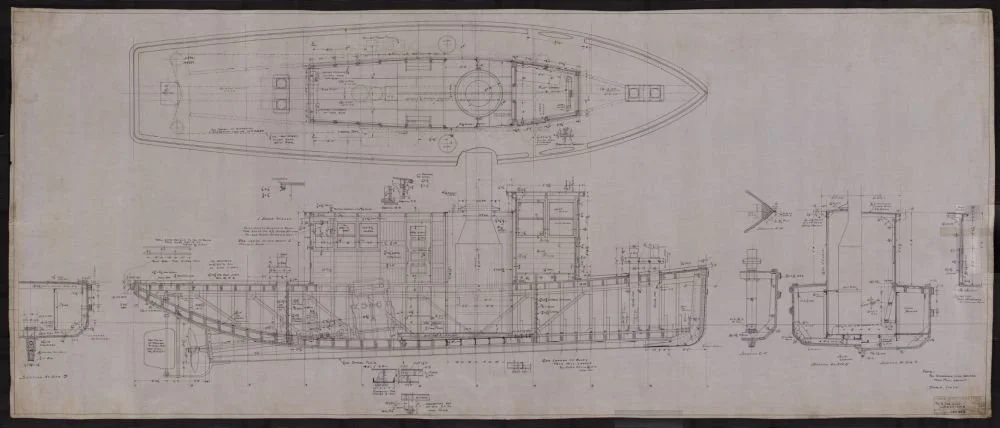
This blueprint depicts Hercules’ dimensions clearly. The 50 foot tug would be comfortably fitted with an enclosed, 7 foot tall, pilothouse made of pine, a hull of largely cypress, and oak decking. All of which was relatively common material at the time. To boot, her funnel (smokestack) had a 2 foot diameter and stood roughly 4 feet above the roof of the pilothouse. As was the case with all steamers of this era, Hercules was coal powered & featured a refueling hatch where coal could be dumped into the opening of her hull.
Interestingly, all windows onboard were sashed so they could be opened & closed individually at the crew’s desire; a design less seen on work boats of the time.
Hercules was completed in the spring of 1917 for a total cost of $5,850. When adjusted for inflation, that total balloons to $162,400, if she were being built today. When compared to other steamers built for the Rapid Transit Company around the same time, this isn’t a wildly high figure.
Unfortunately, her existence was largely considered to be a failure and, in 1926, she was dismantled. Likely alongside the steamboat Minnehaha and others. Later that year, Hercules would be towed into deep water, north of Big Island and sunk in roughly the same location as Minnehaha and some of her sisters.
By this time in 2026, Hercules will have been sitting at the bottom of Lake Minnetonka for an entire century. She is largely undisturbed, being too deep for ice or wave damage. The relatively stable water temperature keeps her hull in a state of near perfect preservation. As is the case with all wooden objects in Minnetonka, there is essentially no degradation. She will continue to rest here, preserved in the water and silt, for centuries to come. A relic of a time where steam powered boats were the ultimate form of transportation.
Image credits:
Tugboat Hercules img: Minnesota Streetcar Museum, Minnesota Digital Library
Blueprint schematic: Lake Minnetonka Historical Society, Minnesota Digital Library