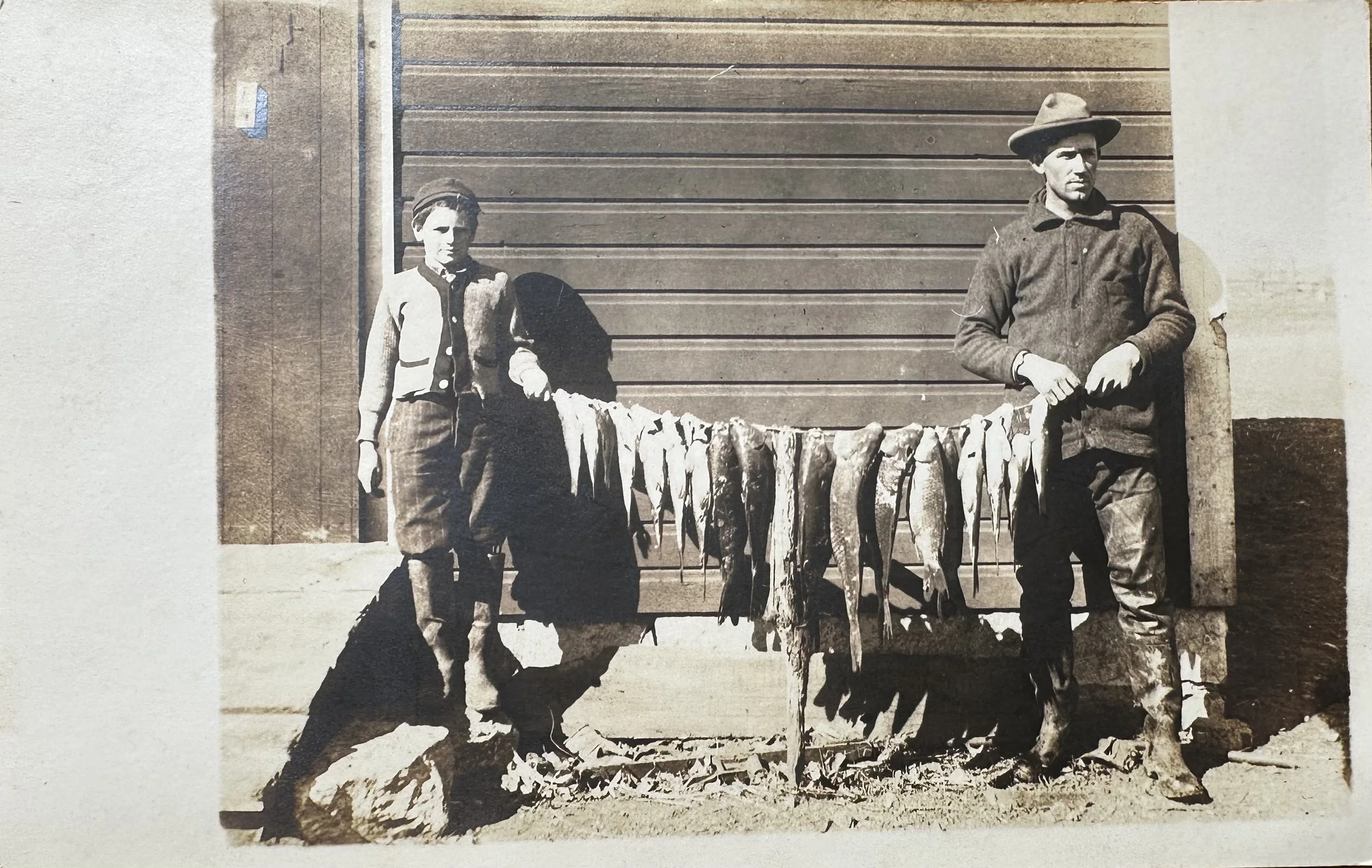
Real photo postcard of a day’s catch on Minnetonka.
Fishing is a time honored tradition for Lake Minnetonka residents and tourists alike! With the heat of summer rapidly approaching, many anglers find themselves adrift in the hopes of catching the best fish of the season. While the modern angler has a bevy of tools at his disposal, the anglers of our past had their own benefits to enjoy. . .
While the avid fishermen likely know this, Minnetonka is home to the following species: Black bullhead, black crappie, bluegill, brown bullhead, green sunfish, hybrid sunfish, largemouth bass, muskellunge, northern pike, pumpkinseed, rock bass, smallmouth bass, tiger muskellunge, walleye, white crappie, yellow bullhead, yellow perch, bowfin (dogfish), white sucker, central mudminnow, common shiner, and golden shiner(1).
The tremendous variety of fish in this lake can be attributed largely to its large size, depth ranges, vegetations, and water temperatures. While many of us think of Minnetonka as one big lake, beneath the surface, it’s quite a different story. These factors make for a wide array of underwater habitats which allow for such a diverse number of fish species. And that’s not even touching on the various flora, bacteria, and mussels!
It couldn’t have been long after the first humans discovered Minnetonka that they began to utilize her bountiful fish population. The Dakota spent prolonged periods fishing on Minnetonka. Their hunter-gatherer lifestyle made them unlikely to overfish or over gather any given area. Thanks to this lifestyle and Minnetonka’s abundance of fish and fish varieties, it was virtually unaffected by native usage.
In the 1850’s, as settlers began making Minnetonka their homesteads, the relationship between man and fish began to rapidly change. By 1856 legislation was enacted at the state level that banned the use of netting on Minnetonka specifically but, even with this legislation in place, enforcement of such rules was difficult at best and impossible at worst. Things weren’t likely to change until, in 1891, the Minnesota Game and Fish Commission would be officially established. But it’s only 1880. The lake’s Golden Era is just warming up and, with it, are coming tens of thousands of tourists—many of whom are looking precisely for the fishing experience.
Hotels and inns of the era often supplied their guests with rowboats, poles, tackle, and bait either as a complimentary perk or for a small fee. Leaderboards were hung in their lobbies which displayed the ranked names of those who had the highest catches of the season. Fishing wasn’t just a pastime, it had been turned into a publicly held competition which saw many expeditions returning to shore with over one hundred pounds in their holds. Yet, even this was a drop in the bucket when compared to the worst offenders of all. . .
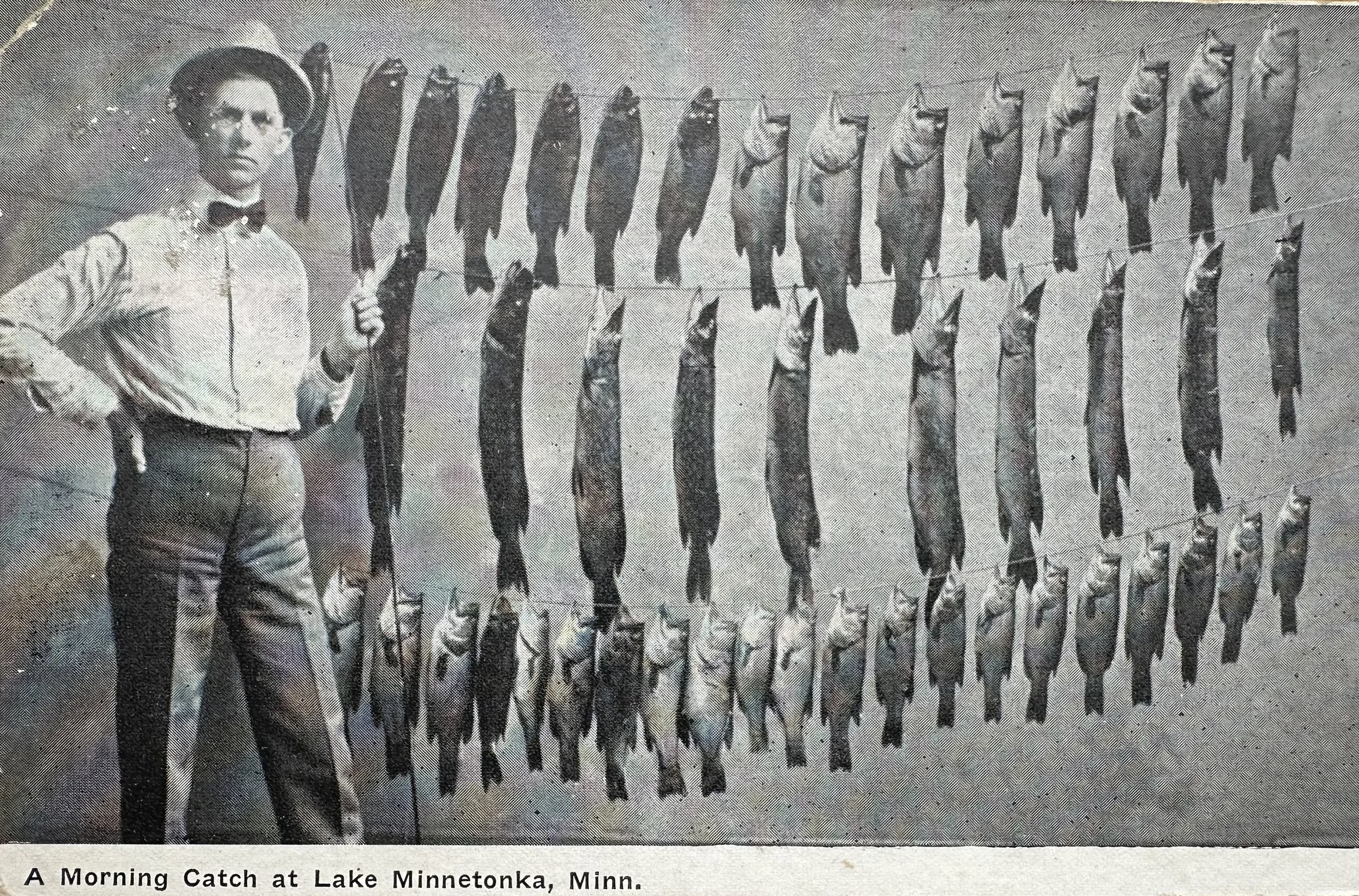
Market fishers, looking to collect and sell their catches to local grocers, essentially scraped the lake of all its fish in the 1880’s. The Excelsior Weekly newspaper summed it up best when they wrote “We wonder if there will be any fish left to attend to spawning and breeding this spring.” Unfortunately, things weren’t quick to change and aquatic animals weren’t the only ones impacted by tourism. Visitors regularly shot a number of birds ranging from ducks to eagles. In fact, while passing by Crane Island on the Upper Lake, steamers would often blow their whistles to rouse the roosting birds from the trees for passengers to gawk at.
Another major blow came in the 1880’s with the introduction of common carp to the lake. In Minnetonka, carp have no natural predators so can live and breed with effectively no natural checks and balances. The invasive fish was intentionally brought to the lake to act as yet another game fish for anglers to enjoy and, in a time before ecological ramifications were fully considered, carp were unleashed into an environment that hadn’t evolved to include them. These large fish cause damage to the native ecosystem in multiple ways but primarily by uprooting weeds and other aquatic vegetation, clouding the water, and destroying other species’ spawning areas. Today they dominate many bays—especially the northern and western bays—with Halsted’s Bay being among the most impacted. A 2018 study by the Minnehaha Creek Watershed District found that there were roughly 89 pounds of carp for every acre of Lake Minnetonka(2). In all, that’s roughly 1,300,000 pounds of carp infesting Minnetonka’s waters, largely in the northwestern quadrant of the lake. Bowfishing, spearing, and government programs do help to mitigate the issue but, realistically, carp are here to stay indefinitely. . .
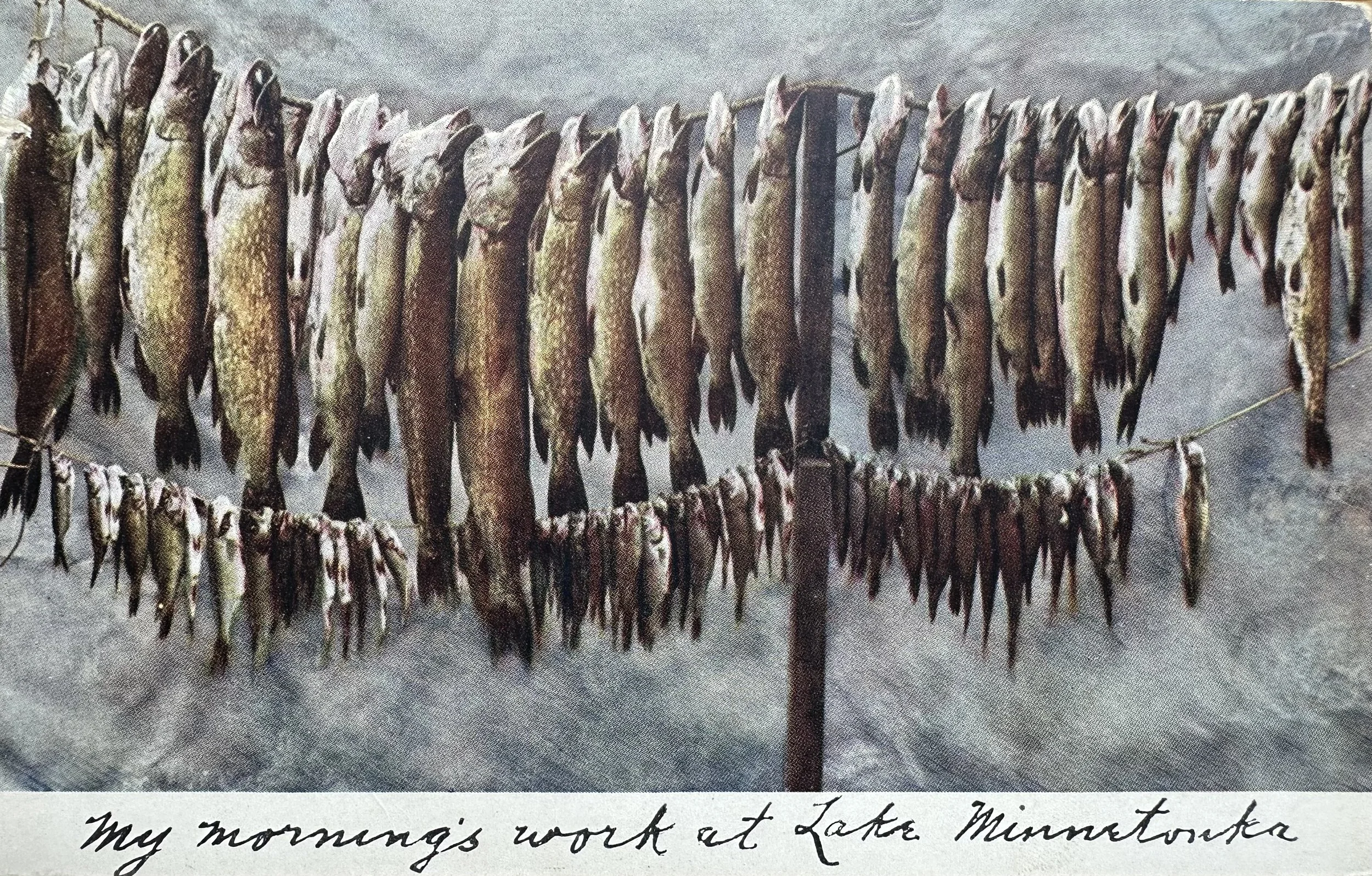
A handwritten note on this card claiming “My morning’s work at Lake Minnetonka.”
While today’s article may sound like all doom and gloom, there is an upside! Modern Minnetonka is well regulated by governing bodies and fishing licenses which help keep local populations in check and today’s fishermen are more careful stewards of the lake’s ecology. Some non-anglers are quick to judge them for their hobby (especially the nighttime carp hunters) but, in truth, they’re doing the lake a much needed favor by helping to prevent overpopulation and invasive carp species. Fortunately for us, the lake has recovered well from the angler’s heyday in the late 19th century. Populations are generally stable, ecosystems are largely recovered, and the fisherman’s passion can exist right alongside it all!
Footnotes:
This list was pulled directly from the LMCD website.
When looking at fish population, measurements are often in overall biomass rather than individual count.
Bibliography of Sources:
Maravelas, 2023, The History of Big Island p.20
LMCD Native Aquatic Species in Minnetonka https://lmcd.org/the-lake/native-aquatic-species-in-lake-minnetonka/
Battle Against Aquatic Invasive Species on Lake Minnetonka Continues https://maisrc.umn.edu/news/lakeminnetonka-ais
10 Year Plan to Rid Minnetonka of Carp https://www.cbsnews.com/minnesota/news/lake-minnetonka-carp-removal/
Six-Mile Creek Halsted Bay Subwatershed https://minnehahacreek.org/wp-content/uploads/2022/11/Six-Mile-Carp-Management-Plan-Final_0.pdf
Controlling Lake Minnetonka Carp Population Proves Challenging https://www.hometownsource.com/laker_pioneer/community/controlling-lake-minnetonka-carp-population-proves-challenging/article_191970f3-4541-4906-9fc0-e7b79d83da6c.html
All images sourced from the Minnetonka Minute private archive.