An Invitation to Hotel Lafayette!
At long last, summer has arrived and, with it, many of us are enjoying the lake in our favorite ways again. June has always been a significant month for Lake Minnetonka residents and businesses, as the influx of visitors to the area boosts business around the community.
The same influx was experienced, perhaps ten fold, by the dozens of lakeside hotels during the late 1800’s. Opening its doors in 1882, Hotel Lafayette was the largest hotel of its time and boasted a capacity of 1,000 guests per night across 300 rooms which all featured a veranda facing either Crystal Bay or Lafayette Bay. Built by railway baron James J. Hill, the hotel was renown for its opulence, comfort, and modern style. Like many local venues, Lafayette typically opened its doors for the season in June. Big names attended summer gatherings here, ranging from U.S. presidents, to European aristocrats, to dignitaries from the Far East.
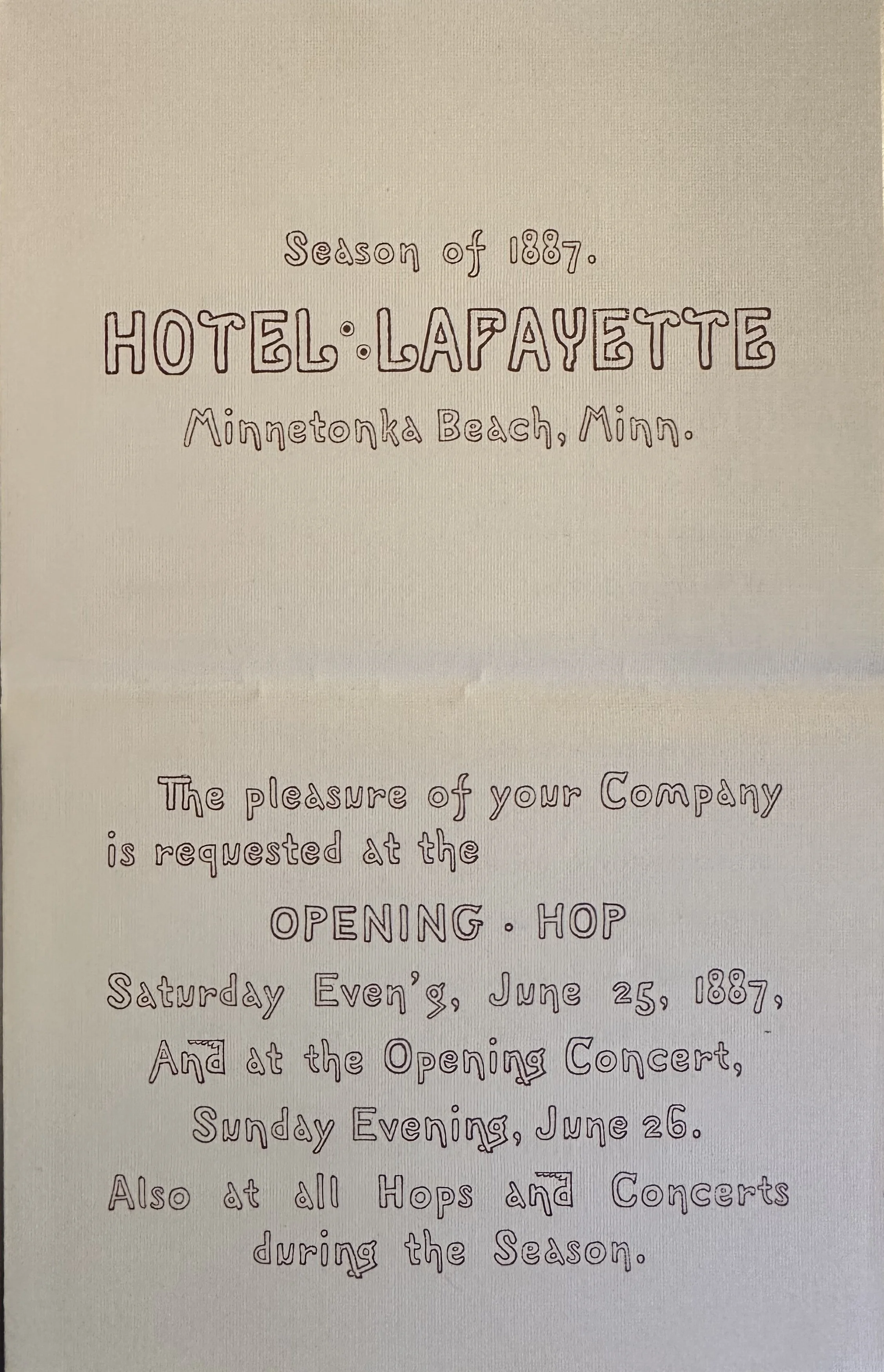
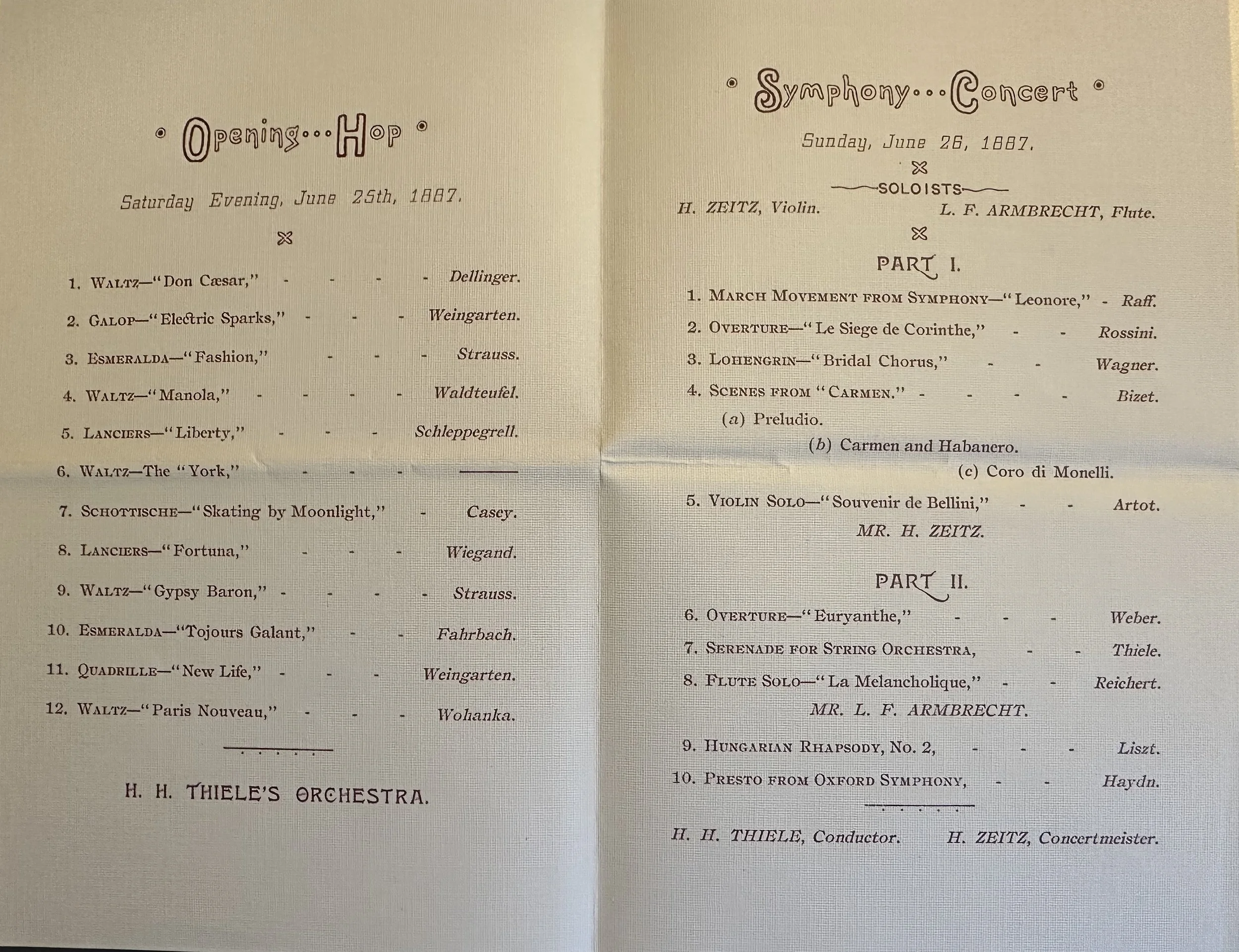
An invitation card—held by the Minnetonka Minute’s private archive—is an exceedingly rare piece of local history that lends insight into the events from one of Hotel Lafayette’s opening weekends. The cover elegantly states the following:
“Season of 1887. Hotel Lafayette Minnetonka Beach, Minn. The pleasure of your company is requested at the Opening Hop Saturday even’g, June 25, 1887, and at the Opening Concert, Sunday Evening, June 26. Also at all hops and concerts during the season.” An opening hop was a social event and dance meant to christen a new building or, in this case, a new season of pleasure and service on Lake Minnetonka. The card goes on to list the twelve songs to be played by live orchestra on that Saturday and another ten on Sunday.
Hotel traffic soon found itself in competition with a new, rapidly growing, clientele: cottage owners. With each passing year, more and more Minneapolis and Saint Paul residents came to Minnetonka with aspirations of owning a sliver of lakeshore upon which they’d build summer (or even year-round) residences. To boot, the Panic of 1893 hit the tourism industry especially hard, forcing the hotel’s closure a month ahead of schedule. Of course, as the market eased, business picked up and the hotel reopened the following summer. No one could predict that, just a few years after the nation had survived a financial devastation, so too would Lafayette face its own devastation.
In the fall of 1897, Lafayette would be completely destroyed by fire. The gargantuan wooden hotel was prime kindling for any spark or unkempt hearth fire to grow into an unstoppable blaze. It was October and the hotel had been closed for the season, put away, and left alone. A nearby fisherman noticed the fire while it was still in its infancy but, to his dismay, it was unable to be put out. He later recounted the events he witnessed.
“A barrel of water would have extinguished it. But no water was at hand. There were pipes leading to the big tank above but they were disconnected. A strong wind kept the fire in the rear wing for half an hour, and then the flames fiercely attacked the main building. In a twinkling, that was all ablaze, for it was but a tinderbox. In twenty minutes, the building was burned to the ground.” Imagine that, if you will. 750 feet long by 95 feet wide covering five acres of land, gone in only twenty short minutes.
Locals, knowing the hotel had been a financial loser for a number of years, speculated the fire might have been intentional. No one could prove it but it certainly looked like that. The water tank had been disconnected, the watchman gone to Minneapolis for the day, and the lone telephone on site was behind a locked door. Nothing was ever proven with regard to fault, if there ever was any to be had.
Lafayette would, of course, be rebuilt and renamed “Lafayette Club” but, one can only imagine when cruising passed the modern property, the melodies that once skipped across the waves during those grand celebrations of the 1880’s. Similarly, the sights to be had from the hotel’s veranda would include steamboats weaving between paddle boats, canoes, and sailboats, making them appear as though they were specks of dust scattered across a deep blue canvas.
Indeed, June is the onset of the most pleasant time for Lake Minnetonka residents, past and present alike!
Bibliography of Sources:
Lake Minnetonka’s Historic Hotels, Meyer, 1997. Pg 48-52
All images from the Minnetonka Minute private archive.