Source: LMHS
Of all the towns dotting Minnetonka’s shores, Navarre is perhaps the closest to a “through town.” Of course many people live in Navarre and, in truth, it’s not its own city. Navarre is a town of Orono and is fully governed by the City of Orono. Despite all of this, Navarre bears no less significance than any other part of the Minnetonka area.
In the 1870’s, the majority of land in Navarre was held by business partners Will Barnes and James Wiley. The duo procured the land and began logging operations with 100 lumberjacks working the area. By 1881, the logging was largely complete and part of the property was sold to James J. Hill and his St. Paul, Minneapolis, and Manitoba Railway for the construction of Hotel Lafayette. For this land, abutting both Crystal Bay and Holmes Bay (now Lafayette Bay), Hill paid an incredible $50 per acre. In all fairness, this was a tremendous increase in value from the Federal Government’s original offering of land on Minnetonka for $1.25 an acre just a couple decades prior. [1]
By 1883, the railway had made its way west of Lafayette and into Navarre proper. The station — located on the southeast corner of where the Dakota Trail intersects with Hwy 19 — was originally named Langdon Park after railway businessman & banker Cavour Langdon. Naturally, the town’s name followed suit and was known as Langdon. It wasn’t until the early 1900’s that the town’s name began to change. Railway employee Samuel Wetherald suggested that the topography of the area reminded him strongly of his visits to Navarre Park, located in Paris. The suggestion conjured scenes of beautiful French landscapes in the minds of the railway officials so they agreed to the change.
As 1910 arrived, the name had been fully cemented and visitors to the station would hear “Navarre” called as their cue to depart. Unfortunately for Cavour Langdon, his name no longer represents the bustling hub of western Minnetonka. However, it does live on elsewhere. . .
Further along the railway and into Mound is another lake. Separated from Cook’s Bay by only a narrow hill is another lake. A drive down Commerce Blvd toward Surfside Beach grants momentary glimpses of this shallow body from between homes, businesses, and trees. This little reservoir, connected to Minnetonka by an outlet no more than three feet wide, is Langdon Lake. Here, lost amongst cattails and bullrushes, the memory of Cavour Langdon lives on. In fact, though likely unintentional, one nonprofit business on Commerce Blvd also bears his name: Langdon Inc.
So all’s well that ends well, since everyone involved is still remembered in one way or another. Plus we feel, with just a little bias, that Navarre is a name much more suitable for a town than Langdon anyway!
Footnotes:
The U.S. Federal Government did not sell land by the acre. Rather, it was sold in plots of 160 acres for $200 plus stipulations.
Bibliography of Sources:
Navarre the Hub of Lake Minnetonka, Wolfe, 2014, pg. 24-26
https://lakeminnetonkamag.com/james-j-hill-lake-minnetonka-history/
Once Upon a Lake, Jones, 1957 - throughout book
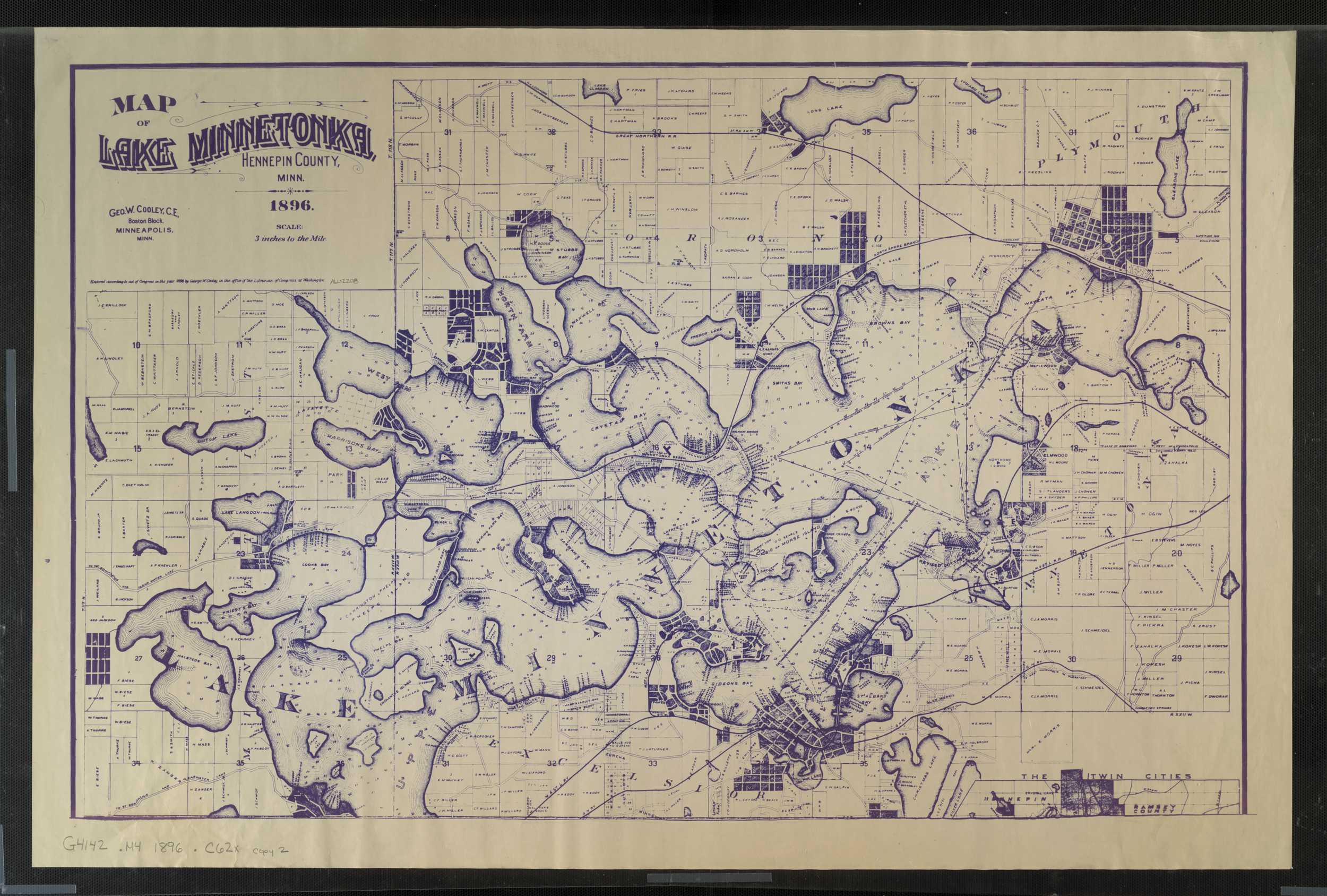
1896 Hennepin County plat map, “Lake Minnetonka only” https://geo.lib.umn.edu/twin_cities_maps/reference/map01452.jpg
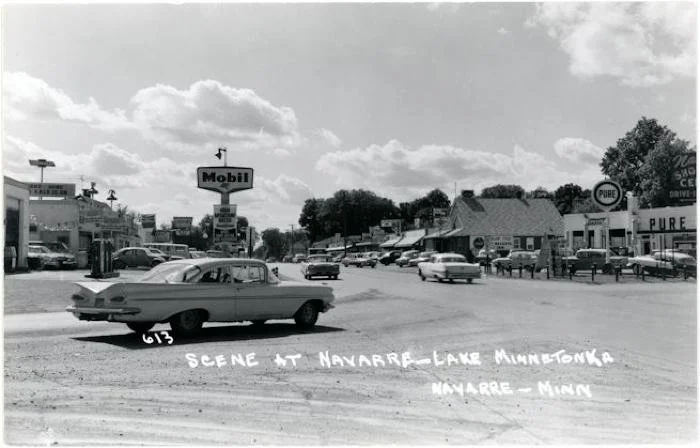
Image Source: LMHS 2022.043.0172